
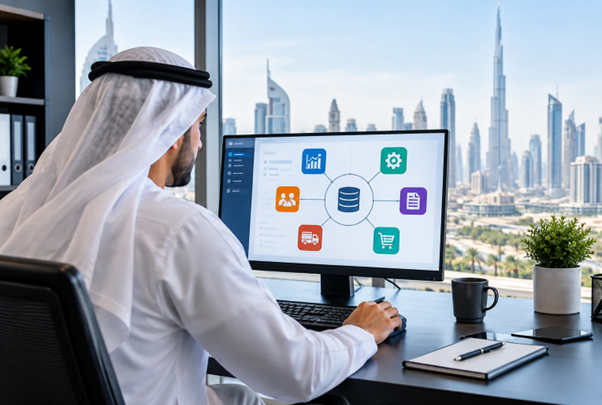
Businesses in the UAE are recognizing the significance of technology in helping them improve efficiencies, oversee operations, and make sound decisions. However, with growth comes the problem of managing finances, sales, stock, HR functions, procurement, customer relations, and other business functions using disparate systems. Here is where ERP software in the UAE comes in handy.
Enterprise Resource Planning (ERP) applications link various business processes using one collaborative system. Instead of relying on individual spreadsheets and software, companies can use one collaborative system to perform all crucial activities and collect information from one spot in the system. Nonetheless, it is not only about selecting a solution with the greatest number of features. Organizations should consider variables like industry and size that will help determine which features are most important.
In this article, our Digital Links team, the ERP solution provider in the UAE, is going to talk about what ERP software is and how organizations can use ERP solutions. We will also outline the benefits of ERP solutions by partnering with the best ERP company in the UAE.
What Is ERP Software?
ERP stands for Enterprise Resource Planning. ERP software is designed to integrate different business functions into a centralized platform. Depending on the system, an organization may be able to manage:
- Accounting and finance
- Sales
- Purchasing
- Inventory
- Human resources
- Payroll
- Customer relationship management
- Manufacturing
- Project management
- Supply chain operations
- Reporting and analytics
When there is no ERP system, the various parts of the organization work in separate applications. For example, a sales team may maintain customer information in one system while the finance department uses another application for invoices and the warehouse uses spreadsheets to track inventory. An ERP system can connect these processes, allowing information to flow between departments.
Why Is ERP Software Important for UAE Businesses?
The United Arab Emirates offers a tough competition to companies in its various industries like logistics, real estate, e-commerce, healthcare, manufacturing, etc. All these industries make use of various ERP systems and solutions to better their activities. As a company tries to grow, there emerge various processes which make it complicated to handle the processes easily. Thus, the use of ERP solutions would help companies to organize their business processes in a simpler way.
Centralized Business Information
The biggest advantage of an ERP system is that it helps companies have all the business-related information in one place. In this case, employees don’t have to deal with many spreadsheets and programs but rather make operations via one system.
Improved Operational Efficiency
The ERP systems help automate the repetitive actions of the workers in the office. This means that the workers will spend more time on real business activities.
Better Financial Management
The information regarding costs can be easily integrated into ERP software. Thus, it demonstrates all the most important points in running business.
Inventory Visibility
Using inventory modules allows businesses to take care of their stock. This is especially important for wholesalers and retailers.
Data-Driven Decisions
Integrated reporting and dashboards can give management access to business information that supports better decision-making.
Key ERP Modules Businesses Should Consider
With the use of ERP technologies, companies can also optimize their sales. The right combination depends on the organization’s industry and requirements.
Finance and Accounting
Financial management is one of the most common ERP requirements. Features may include:
- Accounts payable
- Accounts receivable
- General ledger
- Invoicing
- Expense management
- Financial reporting
- Budgeting
Inventory Management
Inventory modules can help businesses monitor stock levels, movements, purchases, warehouses, and product availability. This can be particularly important for retailers, distributors, manufacturers, and e-commerce businesses.
Sales and CRM
ERP platforms can integrate sales processes with customer information and other business operations. This may include lead management, quotations, sales orders, customer records, and reporting.
Procurement
Procurement modules can help businesses manage suppliers, purchase requests, purchase orders, approvals, and purchasing records.
Human Resources
HR functionality can help organizations manage employee information, leave, attendance, payroll, and other HR processes, depending on the ERP platform.
Reporting and Analytics
Business intelligence and reporting tools can help managers monitor important performance indicators and identify trends.
How to Choose ERP Software in UAE
Choosing an ERP system should begin with understanding your business requirements. Before comparing software vendors, identify the processes you want to improve. Ask questions such as:
- Which processes currently consume the most time?
- Which departments need to share information?
- Where are data errors occurring?
- What reports does management need?
- Which processes should be automated?
- How many users will access the system?
- What integrations are required?
- What are the company’s future growth plans?
Once these requirements are documented, it becomes easier to compare ERP solutions.
Cloud ERP vs On-Premise ERP
One of the decisions businesses need to make is whether to deploy ERP software in the cloud or on their own infrastructure.
Cloud ERP
Cloud ERP is hosted through cloud infrastructure and accessed through the internet. Potential benefits include:
- Remote accessibility
- Easier scalability
- Reduced infrastructure requirements
- Regular updates
- Flexible access
Cloud ERP can be particularly useful for businesses with distributed teams or employees who need access from different locations.
On-Premise ERP
On-premise ERP is installed and managed on the organization’s own infrastructure. This may provide businesses with greater control over their IT environment, although it can require more internal infrastructure and maintenance. The right deployment model depends on factors such as security requirements, IT capabilities, budget, operational needs, and business strategy.
Why Work with an ERP Solutions Provider in the UAE?
ERP implementation involves much more than installing software. A professional ERP solutions provider in the UAE can help organizations assess requirements, select appropriate solutions, configure the system, migrate data, integrate applications, train users, and provide ongoing support. A typical ERP implementation may involve:
- Business requirements analysis
- ERP platform selection
- Project planning
- System configuration
- Data migration
- Integrations
- Testing
- User training
- Deployment
- Ongoing support
Having professional guidance can reduce the risk of choosing an ERP system that does not align with the organization’s actual requirements.
What Makes the Best ERP Company in the UAE?
There is no single ERP platform that is the best choice for every business. When evaluating the best ERP company in the UAE, the businesses should focus on the provider’s ability to understand their specific requirements.
Industry Experience
A provider familiar with your industry may understand your operational challenges more quickly.
ERP Expertise
The provider should have experience with the ERP platforms and technologies relevant to your business.
Implementation Capabilities
Look for a company that can support the complete implementation lifecycle rather than only selling software licences.
Customization
Every organization has different processes. The ERP should be configurable enough to accommodate legitimate business requirements without unnecessary complexity.
Integration
Your ERP may need to connect with CRM systems, payment gateways, e-commerce platforms, payroll systems, banking solutions, or other business applications.
Training and Support
Employees need to understand how to use the new system effectively. Ongoing technical support can also be important after deployment.
ERP Customization and Integration
Businesses should avoid excessive customization whenever possible. Too much customization can make ERP systems more difficult and expensive to maintain. Instead, businesses should first determine whether existing ERP functionality can support their processes through configuration. Where integrations are required, the ERP system can potentially connect with other business applications through APIs or supported connectors.
An experienced ERP provider can help determine which processes should be configured, customized, automated, or integrated.
ERP and Digital Transformation in the UAE
ERP is often an important component of broader digital transformation. Digital transformation consulting in the UAE can help organizations look beyond individual software systems and evaluate how technology can improve their overall business processes. Digital transformation may involve:
- Process automation
- Cloud adoption
- Data integration
- ERP implementation
- CRM integration
- Business intelligence
- Workflow automation
- Digital customer experiences
- Technology modernization
ERP can serve as a central foundation for these initiatives because it connects important business processes and data. However, successful digital transformation requires more than technology. Businesses also need clear objectives, employee adoption, process redesign, training, and ongoing measurement.
Common ERP Implementation Challenges
Resistance to Change
Employees may be comfortable with existing processes. Introducing a new system can require training and change management.
Poor Data Quality
Migrating inaccurate or duplicate data into a new ERP system can create problems. Businesses should clean and validate data before migration.
Unclear Requirements
If the organization has not clearly defined its requirements, it may choose unnecessary modules or overlook important functionality.
Inadequate Training
Even a powerful ERP system will not deliver its full value if employees do not know how to use it.
Unrealistic Expectations
ERP implementation is a business transformation project, not simply a software installation. Organizations should establish realistic timelines and measurable objectives.
How to Make Your ERP Implementation Successful
A structured approach can improve the chances of successful ERP adoption.
Define Clear Objectives
Determine what the ERP system should achieve. For example:
- Reduce manual data entry
- Improve inventory visibility
- Automate financial processes
- Improve reporting
- Connect departments
- Reduce operational duplication
Involve Key Users
Employees who use the system daily should participate in requirements gathering and testing.
Plan Data Migration Carefully
Identify which information needs to be transferred and clean the data before migration.
Provide Training
Training should be tailored to different departments and user roles.
Measure Results
After implementation, track performance against the original objectives.
This allows the organization to identify areas where additional optimization may be required.
Is ERP Suitable for Small and Medium Businesses?
ERP software is not limited to large corporations. Small and medium-sized businesses can also benefit from ERP systems when they need to manage multiple interconnected processes. The key is choosing a system that matches the organization’s size and complexity. A smaller business may not need dozens of modules or highly complex customization. Instead, it may prioritize:
- Accounting
- Sales
- Inventory
- CRM
- Purchasing
- Reporting
As the business grows, additional functionality can potentially be introduced.
The Bottom Line
Choosing the right ERP software in the UAE businesses can rely on requires careful consideration of business requirements, industry processes, scalability, integrations, deployment options, budget, and long-term goals. The right ERP system can connect departments, improve operational visibility, automate repetitive processes, strengthen reporting, and provide management with better access to business information.
Working with Digital Links ERP solutions can make the process easier by supporting requirements analysis, implementation, customization, integration, training, and ongoing support. For organizations pursuing broader digital transformation consulting in the UAE, our ERP can also serve as an important foundation for integrating processes, data, automation, and modern business applications.
Ultimately, the best ERP solution is not necessarily the one with the largest feature list. It is the solution that fits your business, supports your employees, improves your processes, and can scale with your future growth.
Frequently Asked Questions
What is ERP software?
ERP software is an integrated business management system that connects different functions such as finance, sales, inventory, procurement, HR, CRM, and reporting within a centralized platform.
Why do UAE businesses need ERP software?
ERP can help UAE businesses improve operational efficiency, connect departments, automate repetitive processes, improve data visibility, and support better decision-making as the organization grows.
How do I choose the right ERP software in the UAE?
Start by identifying your business requirements and operational challenges. Then compare ERP platforms based on functionality, scalability, integrations, deployment options, implementation requirements, cost, training, and support.
What does an ERP solutions provider do?
Digital Links can assist with requirements analysis, software selection, implementation, configuration, customization, data migration, integrations, user training, and ongoing technical support.
How do I find the best ERP company in the UAE?
Evaluate providers based on ERP expertise, industry experience, implementation capabilities, customization and integration services, customer support, training, and their ability to understand your specific business requirements.
Is cloud ERP better than on-premise ERP?
Neither option is universally better. Cloud ERP can offer flexible access and scalability, while on-premise ERP can provide greater control over infrastructure. The appropriate choice depends on your business, IT environment, security requirements, and budget.
Can ERP software be customized?
Many ERP systems can be configured and customized to meet specific business requirements. However, excessive customization can increase complexity and maintenance costs, so businesses should prioritize standard functionality where practical.
Can ERP integrate with other software?
Yes. Depending on the ERP platform, it can integrate with CRM systems, e-commerce platforms, payment solutions, payroll systems, banking applications, business intelligence tools, and other software.
Is ERP suitable for small businesses?
Yes. Small and medium-sized businesses can use ERP systems to integrate accounting, sales, inventory, purchasing, CRM, and other operations. The key is selecting a solution appropriate for the company’s size and complexity.
How long does ERP implementation take?
Implementation time varies depending on the ERP platform, number of users, business complexity, data migration requirements, integrations, customization, and project scope. A simple implementation may be significantly faster than a large multi-department deployment.
What is digital transformation consulting?
Digital transformation consulting helps businesses evaluate how technology, automation, cloud solutions, data, ERP, CRM, and other digital tools can improve business processes and support strategic objectives.
How does ERP support digital transformation?
ERP can provide a centralized foundation for business data and processes. When integrated with other digital technologies, it can support automation, analytics, workflow improvements, and more connected operations.
What should businesses prepare before implementing ERP?
Businesses should document their processes, define objectives, identify key users, clean existing data, establish implementation priorities, determine integration requirements, and prepare employees for the transition.
Does ERP reduce manual work?
ERP can automate many repetitive activities, including data entry, invoicing workflows, purchasing processes, inventory updates, reporting, and approvals, depending on the platform and configuration.
What are the main benefits of ERP software?
Common benefits include centralized data, improved process efficiency, better reporting, automation, improved collaboration between departments, greater operational visibility, and scalability as the business grows.